A Geological Miracle: The Quarries That Saved the Village
To understand why Butte-aux-Cailles resembles a preserved village in the heart of Haussmannian Paris, one must literally delve beneath the surface. The neighborhood's subsoil is riddled with ancient limestone quarries exploited since the Middle Ages to provide building stone for the capital. These galleries, gradually dug over several centuries, now form a fragile and unstable underground network that paradoxically played a saving role for the neighborhood's identity. Baron Haussmann, during his radical transformation of Paris in the 19th century, carefully avoided these risky areas, deemed too dangerous to support the heavy classical Haussmannian constructions.
This major geological constraint preserved the human scale of the neighborhood. Where Haussmannian breakthroughs razed entire streets and imposed six or seven-story buildings in the rest of Paris, Butte-aux-Cailles retained its low two or three-story houses, narrow alleys, and medieval layout. Architects of the late 19th and early 20th centuries had to work with this underground instability by favoring light constructions, often in brick and millstone, with foundations calculated not to weigh too heavily on the underlying galleries. This historical accident explains the unique charm of the neighborhood, which seems to have escaped from a bygone era.
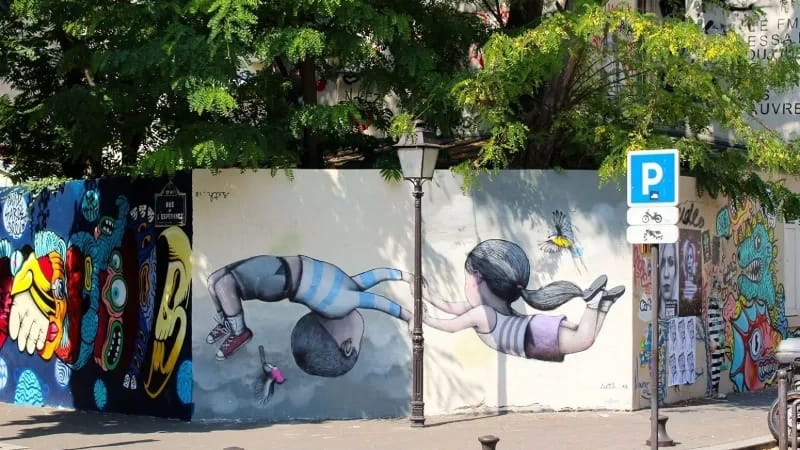
Residents today live with an acute awareness of the void beneath their feet. Some cellars still connect with the ancient quarries, a few streets bear the discreet scars of past subsidence, and the General Inspection of Quarries continues to closely monitor the subsoil's stability. This particular geology is not just a picturesque curiosity: it has shaped the urban topography, imposed a modest building scale, and created the material conditions necessary for the emergence, a century later, of a vibrant street art ecosystem. Without the quarries, there would be no low houses. Without these human-sized facades, there would be no walls accessible to stencils, mosaics, and murals.
Millstone, Brick, Plaster: The Raw Material of Artistic Gesture
Street artists do not paint on just any surface, and Butte-aux-Cailles offers them an exceptional material palette. Millstone, an emblematic material of the early 20th-century Parisian suburbs, is abundant here on the facades of workers' pavilions and townhouses. This rough-textured limestone rock, with its ochre and russet tones and characteristic natural cavities, provides a fascinating canvas for stencil artists. Its texture holds paint differently from a smooth plaster, creating unintended patina effects that often enrich the visual reading of the work.
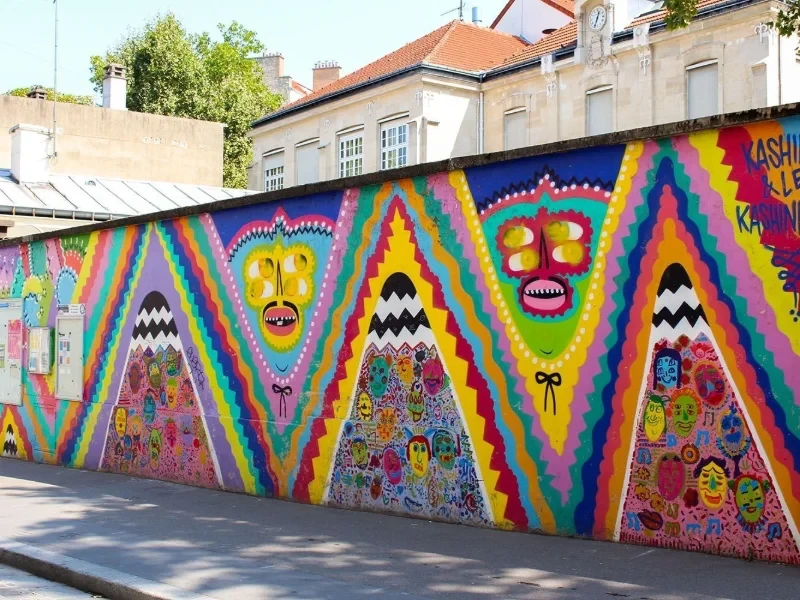
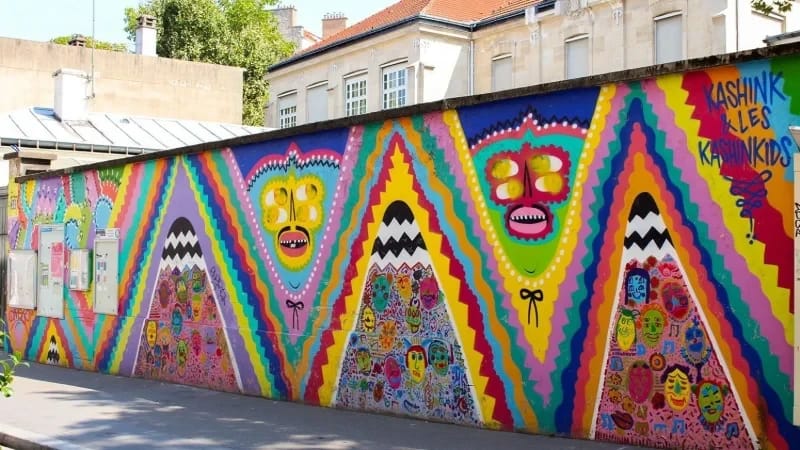
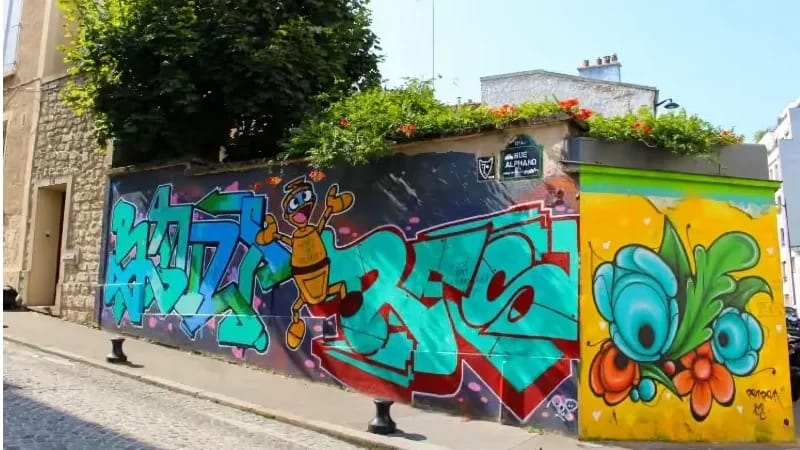
Red brick, present on many Art Deco buildings and garden cities built in the 1920s to rehouse workers, offers another unique type of support. Its flat, regular surface allows for precise stencils, while its warm color dialogues with the chromatic palettes chosen by artists. Some monumental murals in the neighborhood deliberately play with this background hue, integrating it into the composition rather than trying to mask it. This respectful approach to the pre-existing support demonstrates a true artistic culture, far removed from simple graffiti that covers everything indiscriminately.
The traditional plaster of old facades, often tinted in the mass or lime-painted, constitutes the third material pillar of this open-air laboratory. Its soft texture, subtle aging, and sensitivity to weather make it both a fragile and poetic support. Miss Tic particularly loved these patinated plaster walls, on which her stencils seemed to naturally inscribe themselves, as if they had always been there. Space Invader, on the other hand, prefers harder surfaces for fixing his ceramic mosaics, meticulously choosing each location based on the supporting material. This material diversity, rare in Paris, makes Butte-aux-Cailles a valuable exercise ground that pushes each artist to adapt their technique to the support, thus producing works truly in dialogue with their built environment.
Human-Scale Architecture Inviting Artistic Dialogue
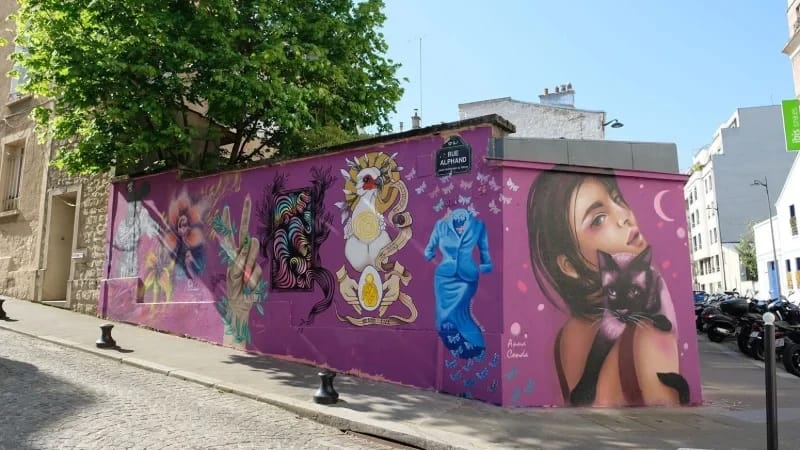
The height of buildings plays a decisive role in the relationship between art and passerby. In Butte-aux-Cailles, most buildings rise to two or three stories, placing available walls at a height immediately accessible to the human gaze. Unlike the grand Haussmannian boulevards where the eye must painfully lift towards intimidating facades, here everything plays out at the scale of the daily walk. Murals and stencils enter the pedestrian's visual field effortlessly, creating an intimacy between the work and the viewer that few Parisian neighborhoods can offer.
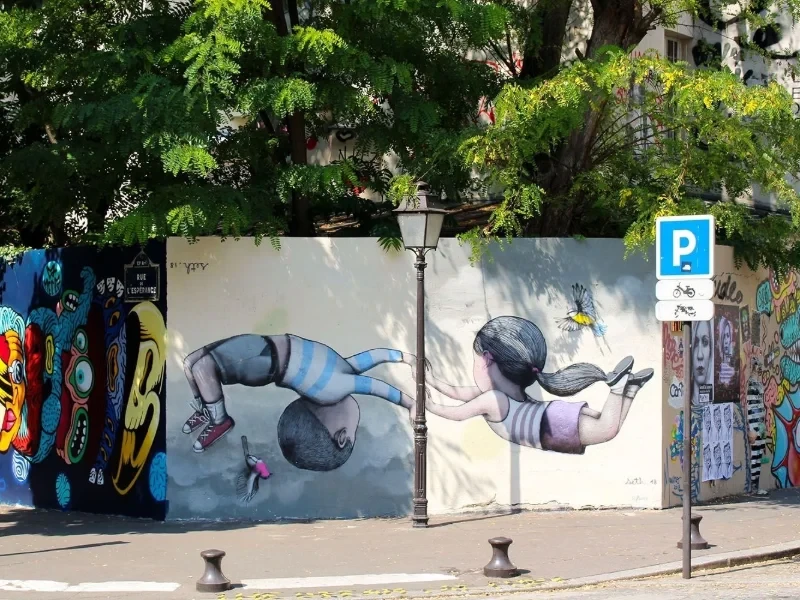
This human scale radically transforms the artistic experience. A Miss Tic stencil hung at eye level invites silent dialogue, almost a confidence. A Jef Aérosol portrait placed on a low facade seems to look the passerby straight in the eye, creating a striking visual encounter. Even Space Invader's mosaics, often placed high up, remain visible from the sidewalk without requiring acrobatic gazes. This physical proximity nurtures an emotional closeness, a form of civic appropriation of the works that largely explains the residents' attachment to their artistic heritage.
The narrow and winding alleys add an additional dimension to this unique experience. Unlike straight avenues where the gaze carries far ahead, here every street corner holds a surprise, every turn can reveal a new work. The neighborhood's labyrinthine topography creates a permanent discovery effect, a form of spontaneous urban scenography where the architecture itself becomes the stage for the works. This rare quality makes Butte-aux-Cailles much more than just a street art trail: it offers a global immersive experience where the built environment and art respond to each other in a loop, each sublimating the other in a permanent dialogue that enchants all who take the time to walk slowly through it.
Explore the Alleys of the Butte on a Unique Guided Tour
This architectural and material richness largely goes unnoticed by the solitary walker, focused on the works without perceiving the subtle dialogue they maintain with their supports. An expert guide opens your eyes to this essential dimension of street art in Butte-aux-Cailles. To experience this cross between architecture, materials, and contemporary creation, the Paris Street Art à la Butte-aux-Cailles offers you an immersive 1.5-hour walking tour from Corvisart metro, designed to reveal the complete artistic ecosystem of the neighborhood at a very affordable price of 14,50 €.
The guide teaches you to recognize the different materials, understand how each artist dialogues with their support, and identify the technical subtleties that stencil artists and mosaicists develop to adapt to the specific material constraints of the neighborhood. They also tell you the fascinating geological history of the underground quarries, the episode of past subsidence, the discreet action of the General Inspection of Quarries, and the decisive role this fragile subsoil has played in the miraculous preservation of the village. These intertwined stories radically transform your reading of the neighborhood.
This multidisciplinary approach, blending art history, architecture, geology, and urban sociology, makes a guided tour far more valuable than a simple solo walk. You will never see a painted wall the same way again after understanding how the support determines the gesture, how the material shapes the work, and how the built scale conditions the relationship between the artist and the passerby. A rare and truly immersive cultural experience, in a Parisian neighborhood like no other, that will make you love Paris like never before.