Allan Kardec, the Father of Spiritualism and His Most Visited Tomb in France
He is probably one of the most astonishing figures of Père Lachaise. Hippolyte Léon Denizard Rivail, born in Lyon in 1804, became Allan Kardec through the magic of a mediumistic revelation. Under this pseudonym, he founded in the mid-19th century a doctrine that would ignite all of Europe and beyond: spiritualism. His major work, "The Book of Spirits," published in 1857, remains a reference text today for millions of followers, especially in Brazil where his thought has become an unofficial religion practiced by more than thirty million people.
When Allan Kardec died in 1869, his disciples erected a monument in his honor in the 44th division of Père Lachaise: an imposing dolmen inspired by Celtic megaliths, topped with a bronze bust of the master. Engraved on the stone is his motto: "To be born, to die, to be reborn again and to keep progressing, that is the law." These words resonate as a complete metaphysical program, at the crossroads of philosophy, religion, and popular spirituality.
What immediately strikes the visitor is the fervor surrounding this tomb. Unlike the neighboring graves, often neglected, Kardec's is never empty. Fresh flowers are placed there every day, in all seasons. Followers come from Rio, São Paulo, Geneva, or Barcelona to meditate for a few minutes. Some place their forehead on the bust, others whisper requests, while others take a silent photograph.
Officially, his grave is the most flowered in the entire cemetery, even surpassing that of Jim Morrison or Édith Piaf. An unknown record to the general public that speaks volumes about the spiritual power that still emanates from this place, more than 150 years after the master's death.
Contemporary Rites Around Allan Kardec's Tomb
The atmosphere around Allan Kardec's dolmen is unique in all of Paris. It blends religious contemplation, spiritual quest, and popular beliefs in a permanent ballet that fascinates observers and intrigues passing tourists.
The most widespread ritual involves placing one's left hand on the master's bronze bust while making a wish or asking a question. According to spiritualist tradition, the energy of the place would allow one to "recharge" their aura, find inner answers, or obtain healing. The bronze of the bust, polished by millions of hands over the decades, literally shines with wear at strategic points: the forehead, the cheek, the shoulder. This human patina testifies better than any speech to the vitality of the contemporary cult.
Another widely observed rite: the deposit of personal objects. You will see at its feet photographs of deceased loved ones, letters folded in four, locks of hair, embroidered handkerchiefs, coins from all countries. Each object corresponds to a request, an intention, a silent dialogue with the beyond. The cemetery keepers leave these offerings in place for several days before proceeding with a respectful sorting.
Some more experienced followers come in groups to organize real collective meditation sessions. It is not uncommon, in the late afternoon, to come across a dozen people forming a circle hand in hand around the dolmen, murmuring prayers or invocations. The scene is something moving, a thousand miles from the usual tourist folklore.
On March 31, the anniversary of Kardec's death, the tomb is literally covered with thousands of flowers. Spiritualist delegations from around the world gather there for an international ceremony that attracts cameras and transforms Père Lachaise into the world epicenter of spiritualism.
Other Esoteric Figures of Père Lachaise
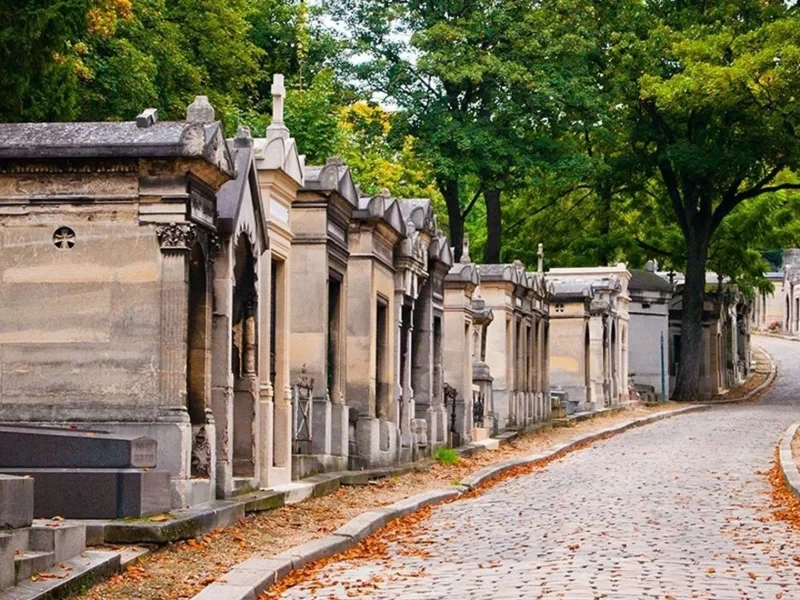
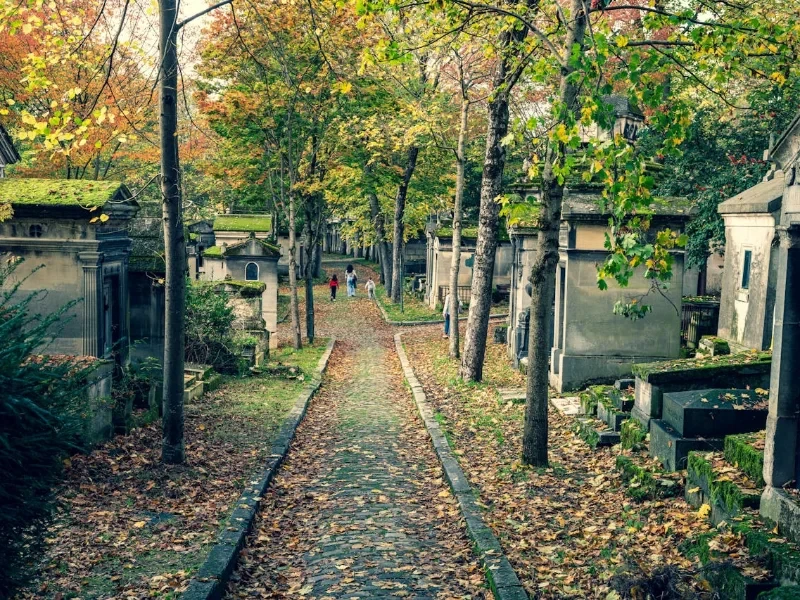
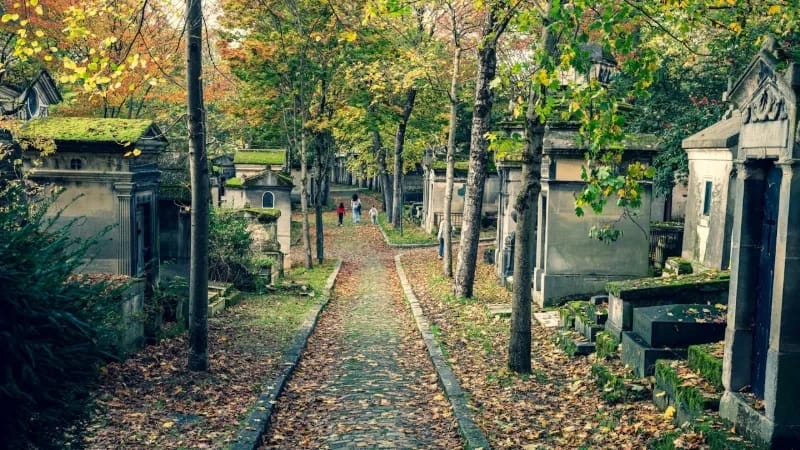
Kardec is not the only mystic resting in these alleys. Père Lachaise is actually a true open-air temple for those interested in the esoteric currents of the 19th century. This period, straddling scientific rationalism and spiritual renewal, saw the birth of numerous secret societies and occult sensibilities in Paris, traces of which are still readable on the tombs if one knows how to decipher the symbols.
You will discover the grave of Éliphas Lévi, whose real name was Alphonse Louis Constant. This former seminarian turned great theorist of modern magic has left a lasting mark on Western thought. His works, notably "Dogma and Ritual of High Magic," have influenced both the surrealists and the infamous Aleister Crowley. His tomb, relatively modest, is a discreet pilgrimage site for lovers of hermetic traditions.
Not far away, you will find several graves adorned with alchemical symbols: pelicans tearing their chests (symbol of sacrifice and spiritual transmutation), ouroboros (snake biting its tail, symbol of eternal return), radiant triangles, mystical roses. These motifs, discreetly engraved on seemingly ordinary steles, reveal their occupants' belonging to discreet initiatory circles.
Père Lachaise also houses several graves of major figures of the French Freemasonry. Recognizable by their squares, compasses, broken columns, and sculpted acacias, these tombs form a discreet but impressive network. The painter Camille Pissarro, for example, rests there not far from other initiated brothers whose stories form a true secret geography of the cemetery.
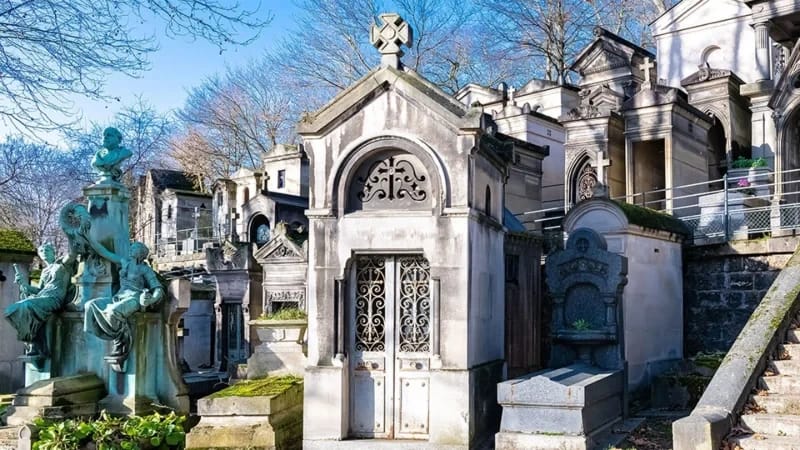
Not to mention the mausoleums of bourgeois families passionate about table-turning, very fashionable under the Second Empire, whose steles sometimes bear ambiguous inscriptions evoking the belief in the survival of the soul and communication with the deceased.
Experience Occult Paris with Our Guide
Deciphering all these symbols alone is an impossible mission. Each sign has several levels of reading, each location reveals complex intellectual affiliations, each era has its own codes. This is where an expert guide radically transforms your visiting experience.
Our Visite guidée du Père-Lachaise opens the doors of esoteric Père Lachaise under the guidance of a lecturer specially trained in the history of 19th-century spiritual currents. In two hours, you will walk through the most significant alleys, stop in front of Kardec of course, but also in front of Éliphas Lévi, the great Masonic tombs, and several graves whose astonishing symbols had remained hermetic to you until then.
Your guide will tell you the story of the Second Empire, this bubbling era when Parisian elites organized spiritualist sessions in gilded salons, where Victor Hugo himself tried to communicate with his deceased daughter from his exile in Jersey, and where the boundaries between science and the supernatural still seemed porous. You will understand why Kardecist spiritualism met with such popular success, how it spread to Latin America, and why it continues today to gather millions of fervent followers.
The experience is accessible from 14,50 €, a very reasonable price for two hours of immersion in a little-known part of French cultural history. The visit is particularly well-suited for scheduling at the end of the day, when the light fades between the steles and the atmosphere takes on a truly mystical dimension.
Groups are kept small to preserve the solemnity of the place and allow everyone time for contemplation. Book your slot today and let yourself be initiated into hidden Paris, the one of symbols, rites, and mysteries that still throb beneath the moss of old stones.