The Origins : The Jesuit Garden of Père La Chaise under Louis XIV
Few Parisians know that Père Lachaise is named after a real historical figure: Father François d'Aix de La Chaise, an influential Jesuit and personal confessor to King Louis XIV for more than thirty-four years. We are at the end of the 17th century. Louis XIV, known as the Sun King, reigns over a triumphant France, and his confessor exerts considerable influence at his side, both spiritually and politically.
In 1682, the Jesuits purchased a vast estate on the heights of the hill known as "Champ-l'Évêque", to the east of Paris, away from the capital. This steep location, planted with vines and fruit trees, offers a splendid view of the city and becomes a favored retreat for the order. Father La Chaise regularly stays there, hosting important social and political receptions, and even welcomes King Louis XIV himself on several occasions. The estate, known as "Mont-Louis" (in honor of the king), becomes one of the most sought-after places of the grand century.
Father La Chaise dies in 1709, but his memory remains attached to this place. After the expulsion of the Jesuits from France in 1763, the estate passes through several private hands, experiencing periods of prosperity and neglect, before being finally purchased by the City of Paris in 1804. No one then knows that this simple countryside estate will become, in less than two centuries, one of the most visited and mythical places in the French capital.
Note this etymological curiosity: the name "Père Lachaise" remained attached to the place, even though the historical figure was more precisely called "Père La Chaise". A small popular deformation that has crossed the centuries and given the cemetery its definitive identity.
The Creation by Napoleon and the Early Difficult Years
The history of the cemetery as we know it truly begins on May 21, 1804. On that day, an imperial decree signed by Napoleon Bonaparte establishes the creation of several extra-mural cemeteries in Paris. The reason is eminently sanitary: by the end of the 18th century, the intra-mural Parisian cemeteries are overcrowded, unsanitary, and pose a major epidemiological risk. The famous Cemetery of the Innocents, in the heart of Paris, had to be closed in 1780 after a mass grave collapse flooded neighboring cellars with decomposing bodies.
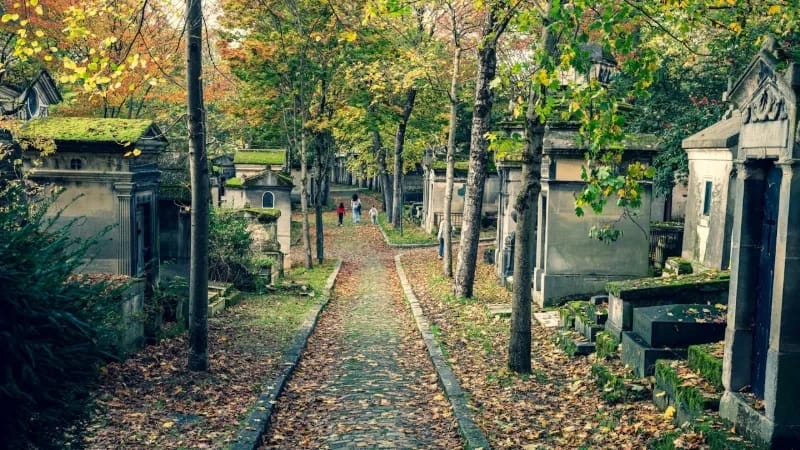
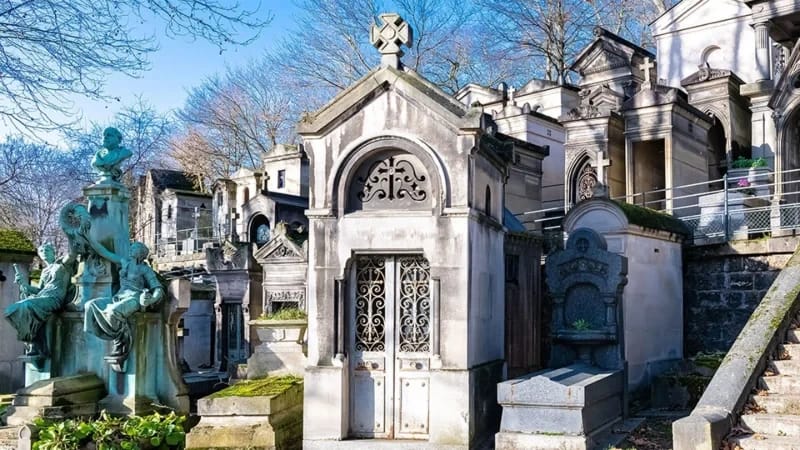
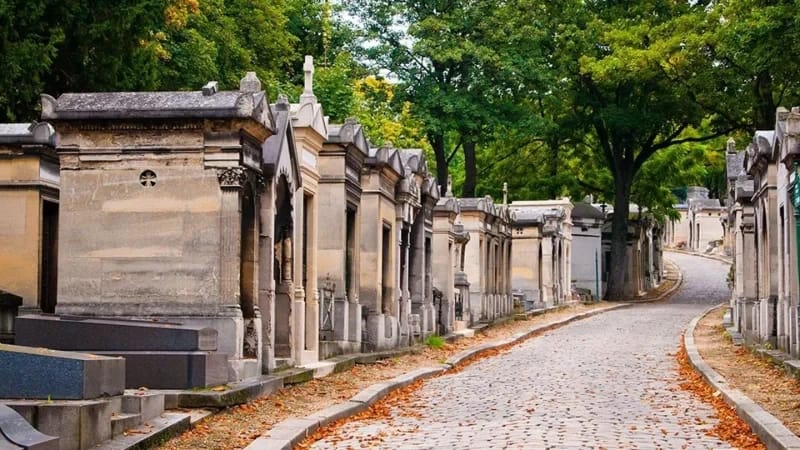
Napoleon entrusts the architect Alexandre-Théodore Brongniart, also the designer of the Palais Brongniart, with the design of the new cemetery of Mont-Louis, renamed "East Cemetery" and then "Père Lachaise Cemetery". Brongniart imagines a radically innovative place: an English-style garden cemetery, with winding paths following the natural curves of the hill, personalized monuments inspired by antiquity, and abundant vegetation. It is a revolution in French funerary design, previously dominated by anonymous mass graves and ossuaries.
However, the beginnings are laborious. Parisians shun the new cemetery, considered too far from the historic center. Its location in a still rural suburb, barely served and perceived as "outside the city", discourages bourgeois families who prefer to bury their deceased in more central cemeteries. After several years, there are only a few dozen burials, insignificant compared to the site's capacity.
It is then that the City of Paris has a stroke of marketing genius before its time. In 1817, it decides to transfer the remains of illustrious figures to Père Lachaise with great pomp. Molière and Jean de La Fontaine lead the way, followed in 1817 by the legendary medieval lovers, Héloïse and Abélard, whose Gothic mausoleum is installed in the 7th division. The operation is a triumph. Parisians flock to the cemetery, concessions sell, and great bourgeois families compete for plots.
The Haussmann Era and the Heritage Explosion of the 19th Century
The mid-19th century sees Père Lachaise enter its golden age. Under the Second Empire of Napoleon III and the great urban transformation led by Baron Georges Eugène Haussmann between 1853 and 1870, Paris is radically transformed. Wide boulevards, Haussmannian buildings, parks, and public gardens: the capital modernizes at full speed. Père Lachaise fully embraces this movement.
The cemetery expands several times (1824, 1825, 1832, 1842, 1850) to finally reach the 44 hectares we know today. It gradually encompasses the surrounding hills, absorbs former gardens, and definitively transforms the landscape of eastern Paris. Access is facilitated by new boulevards, and the construction of the metro at the end of the century completes the opening up of the neighborhood.
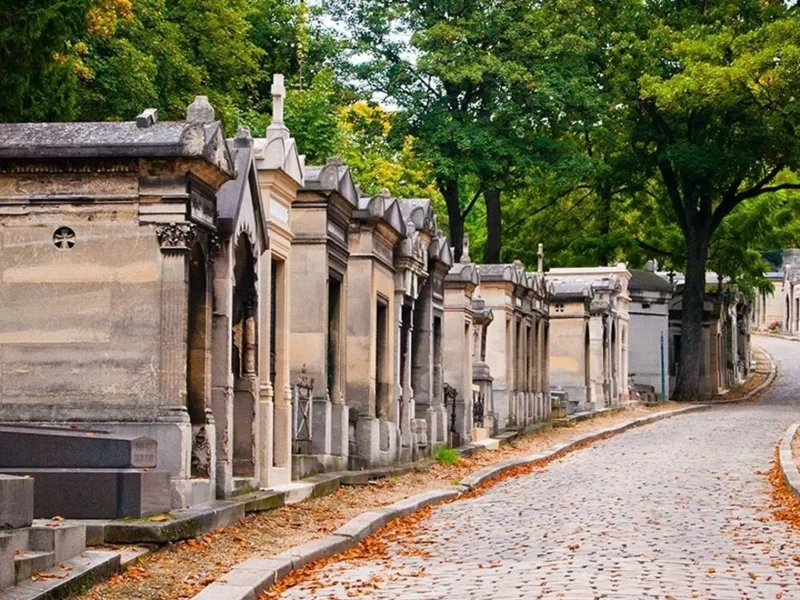
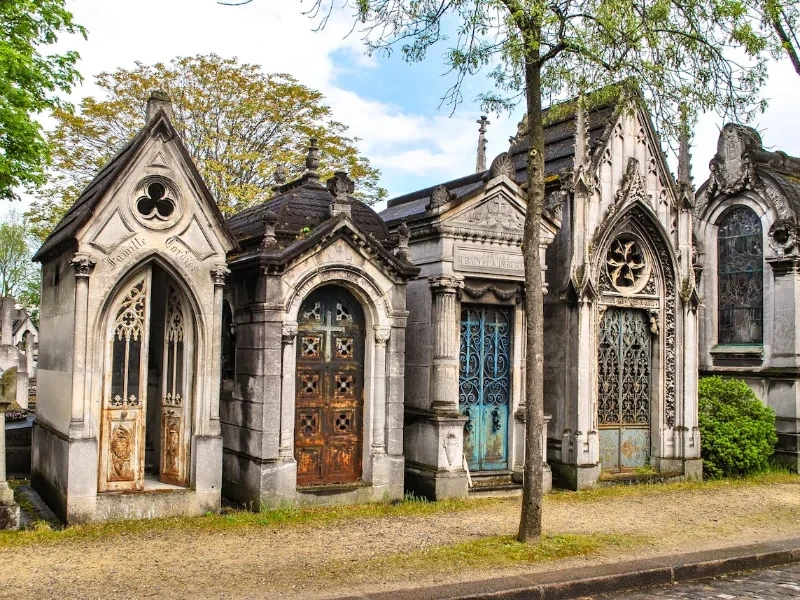
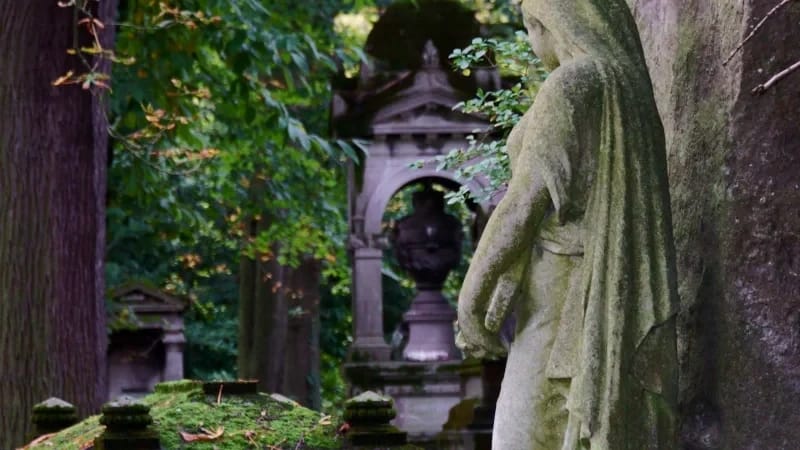
It is also during this period that the most sumptuous funerary art of the cemetery flourishes. The great architects, sculptors, and artists of the time express themselves without restraint. Flamboyant neo-Gothic, rigorous neo-classicism, oriental eclecticism, emerging art nouveau: all styles coexist in the alleys. The great bourgeois families rival in prestige by commissioning ever more imposing mausoleums, ever more elaborate chapels, and ever more moving statues. It is a true golden age of French funerary sculpture.
Père Lachaise is also a witness to dramatic historical moments. In May 1871, it is the scene of the Bloody Week that ends the Paris Commune. The last communards are cornered in the cemetery alleys, where desperate hand-to-hand combat takes place among the steles and mausoleums. 147 of them are finally shot on May 28 against a cemetery wall, known since as the Wall of the Federates. Buried in a mass grave, they are now the subject of an annual pilgrimage that recalls this tragic page of French history.
By the end of the 19th century, Père Lachaise has become what it still is today: the largest cemetery-museum in the world, a pantheon of international artists, a temple of funerary art, and a universal place of memory.
Discover This Incredible Historical Saga on the Ground
Reading the history of Père Lachaise is fascinating. But experiencing it on the ground, physically walking the alleys where these events took place, placing your hand on the stones that witnessed these centuries, offers a completely different emotion. This is precisely what our Visite guidée du Père-Lachaise offers you: an immersive two-hour dive into the cemetery's history, led by a passionate and expert lecturer.
Your guide takes you on the concrete traces of this historical saga. You will stop in front of the 7th division to understand how the transfer of Héloïse and Abélard saved the cemetery in 1817. You will walk the paths designed by Brongniart to appreciate his revolutionary architectural vision. You will discover the tombs of bourgeois families from the Second Empire, whose mausoleums alone tell an entire era. Finally, you will pay your respects at the Wall of the Federates to understand the political stakes of the Paris Commune.
This journey radically transforms your perception of the place. It is no longer just a cemetery you are visiting: it is a living history book, where each stone tells a specific moment of the great French narrative. You leave with a deeper understanding of 19th century Paris, its urban transformations, its political dramas, and its extraordinary cultural richness.
The experience is available from 14,50 €, a very reasonable price for two hours of dense historical content delivered by a passionate expert. Our groups are deliberately kept small (10 to 15 participants) to preserve the quality of listening and interaction with the guide.
Book your spot now: it's the promise of a visit that will remain etched in your memory, far beyond a simple tourist stay in Paris.