Emergency excavations under the crossing of the transept
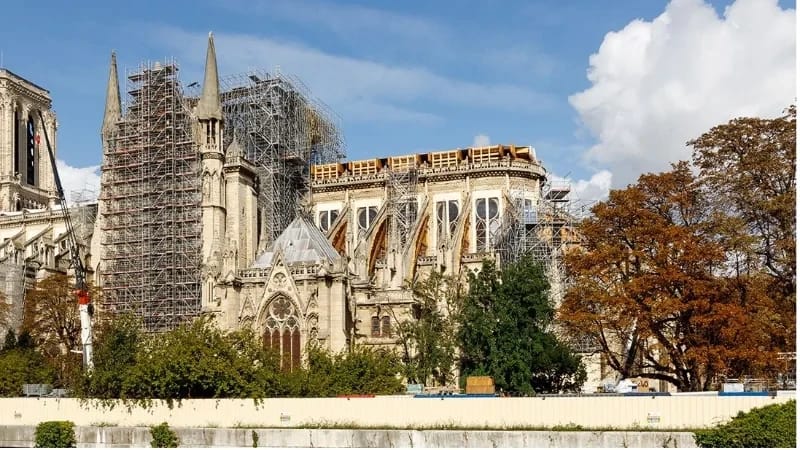
It all begins in February 2022. As the reconstruction teams prepare to install a colossal scaffolding to rebuild the spire, an archaeological diagnosis is required under the crossing of the transept. French law mandates it before any major excavation on a listed site. The National Institute for Preventive Archaeological Research, INRAP, sends a small team under the direction of Christophe Besnier. What these archaeologists believe to be a routine operation - a few weeks of surveying - turns into a historical discovery in less than ten days.
Under a thin layer of liturgical rubble and tiles reworked in the 19th century by Viollet-le-Duc, trowels uncover a sculpted architectural decor from the 13th century: polychrome fragments of the medieval rood screen dismantled in the 18th century. The scientists are amazed. Then, a lead shard. Another. The outline of a coffin appears. Silence in the nave. Then a second outline a few meters away. Two anthropomorphic lead sarcophagi, placed at different times, have lain there for centuries without anyone suspecting their existence. The cathedral, which was to reveal its architectural secrets, suddenly unveils its funerary secrets. The restoration site becomes a major archaeological site, under the cameras of the world.
The meticulous extraction of the two lead coffins
The extraction operation, conducted in April 2022, is akin to surgery. The coffins, weakened by centuries, are first consolidated on site. Then they are lifted using a crane through a temporary opening in the still gaping roof. Destination: the laboratory of the Forensic Institute in Toulouse, under scientific seal. A logistical feat worthy of the great pharaonic projects, carried out in the heart of Paris.
What did the exhumed sarcophagi from the cathedral contain?
The first coffin, in excellent state of preservation, bore a engraved copper plate. The Latin inscription quickly removes any doubt: it is Antoine de La Porte, canon of Notre-Dame, who died in 1710 at the age of eighty-three. A wealthy man, he had funded the renovation of the baroque choir of the cathedral during his lifetime and wished to rest near the high altar. His skeleton, hair, and part of his liturgical garments were still identifiable. DNA analyses confirmed his excellent health for the time and his rich diet.
The second sarcophagus presented a different caliber of enigma. Dating from the mid-14th century, it contained the remains of a young man, between twenty-five and forty years old, suffering from severe cranial bone deformations - probably related to intensive equestrian practice from childhood. The excavators nicknamed him "The Rider". Fragments of green and vegetal fabric, as well as a flower crown placed near his head, were found. The current hypothesis leans towards a young noble or a high-ranking ecclesiastical dignitary, but his formal identity still eludes researchers. Isotopic analyses will soon help determine his birthplace and life journey. The medieval history of Paris is being written before our eyes.
Anthropological analyses and medieval fabric fragments
The fabrics found, protected by the anaerobic atmosphere of the lead, offer an exceptional snapshot of medieval funerary textiles. Paleopathologists have also identified unprecedented indications of lifestyle, diet, and ritual practices. A true intact time capsule, offered to science by the tragedy of 2019.
How to relive these discoveries during a thematic guided tour
Reading a scientific article remains abstract. Standing in front of the exact location where "The Rider" rested, under the crossing of the transept, radically transforms the experience. This is what Notre-Dame de Paris : les mystères de sa reconstruction offers: a ninety-minute tour around the cathedral, led by an official lecturer who deciphers the archaeological discoveries in their topographical context. From the forecourt, your guide shows you the precise location of the excavations, the successive historical strata, and how INRAP worked in coordination with the restoration project management.
The narrative is not limited to the sarcophagi. You also discover the fragments of the medieval rood screen, the remains of the parish cemetery prior to the 13th century, and the traces of underlying Gallo-Roman buildings. The Île de la Cité, the historical heart of Lutetia and then Paris, reveals two thousand years of urban sedimentation to anyone who takes the time to listen. Each anecdote is based on official publications from INRAP and statements from the Ministry of Culture. To enjoy this rare heritage immersion and leave with new interpretive keys, count 14,50 € - a modest investment compared to the richness of the content delivered live by a field expert.
Follow the historic slabs with a lecturer guide
Meet at Pont au Double, e-ticket on your smartphone, comfortable shoes on your feet. The route takes you from square René Viviani to the forecourt via the apse, with precise stops in front of the areas that have yielded archaeological discoveries. A 1.5-hour dive into living archaeology, without academic jargon but with all the expected scientific rigor.