Eugène Viollet-le-Duc and the 19th Century Stroke of Genius
Contrary to what many tourists believe, the original spire of Notre-Dame was not strictly medieval. An initial spire was indeed built in the 13th century above the transept crossing, but it was dismantled in 1786, deemed too fragile after centuries of exposure to the winds. For over seventy years, the cathedral stood without a spire, a truncated silhouette in the Parisian sky. It wasn't until the mid-19th century that a young visionary architect decided to restore its lost verticality: Eugène Viollet-le-Duc.
Commissioned in 1844 with his associate Jean-Baptiste Lassus for the general restoration of Notre-Dame, then in a state of advanced decay after the Revolution, Viollet-le-Duc proposed in 1857 the design of a new spire. His architectural gesture was masterful: he did not mechanically copy existing medieval models, he reinvented their logic. His spire was inspired by that of the Orléans Cathedral and several Norman Gothic models, while integrating personal innovations such as the sixteen monumental copper statues of apostles and evangelists surrounding it. Completed in 1859, it rose to 96 meters and quickly became one of the universal symbols of Paris, immortalized by millions of photographs before its tragic fall in 2019.
Why the Original Spire Became a Universal Symbol
Viollet-le-Duc's spire was not merely decorative. It housed in its base a reliquary containing a fragment of the Crown of Thorns, relics of Saint Genevieve and Saint Denis. On its weathercock, miraculously recovered intact after the fall, three precious relics were placed in 1935. It was thus both a monument, a work of art, and a vertical sanctuary. A condensed version of Paris itself.
The Shock of Its Fall and the Technical Challenge of Its Reconstruction
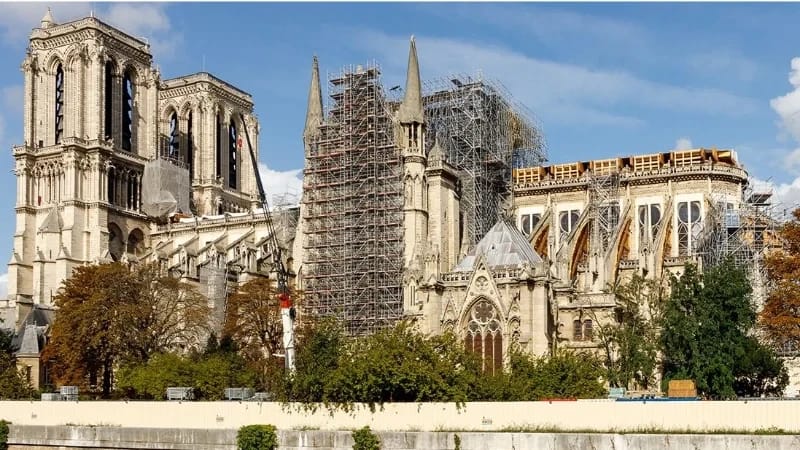
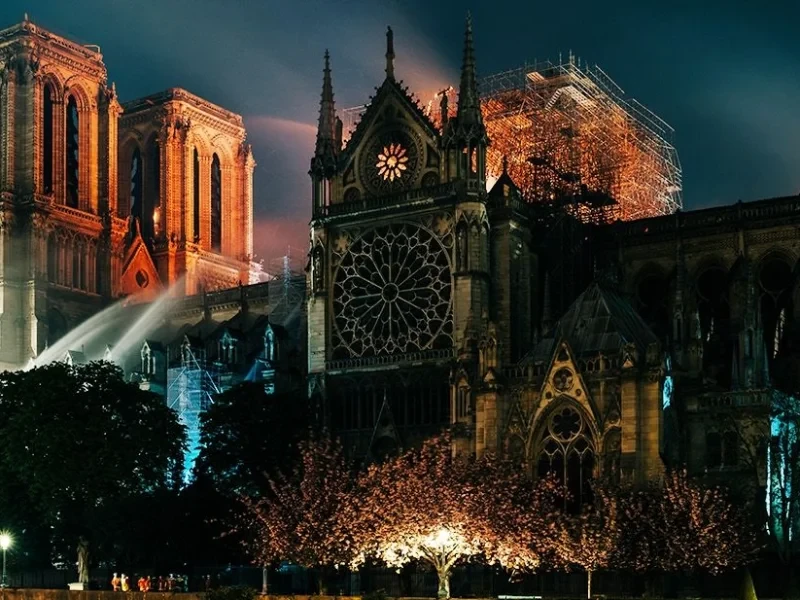
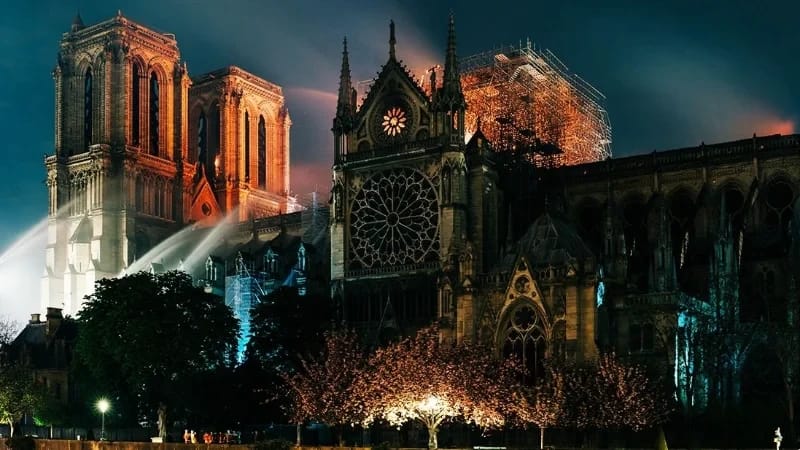
On April 15, 2019, at precisely 7:50 PM, the spire slowly collapsed and then toppled through the vault, in a petrified silence. Millions of viewers watched this apocalyptic scene live. The images circled the globe in minutes. Five days later, the President of the Republic announced the reconstruction and launched an international architectural competition. For months, the most audacious proposals flourished: a crystal spire, a hanging garden, a luminous glass flame. The debate captivated all of France. Finally, in July 2020, the National Heritage Commission decided: it would be an identical reconstruction, gesture for gesture, beam for beam.
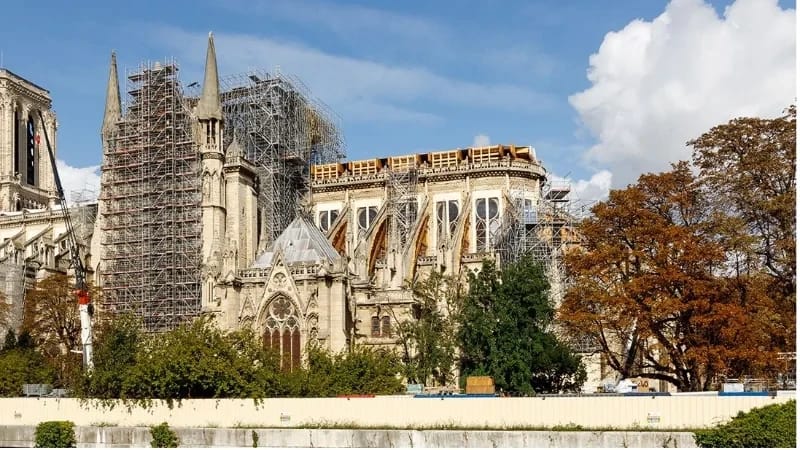
The technical challenge is colossal. It requires reproducing a framework weighing over 500 tons, entirely in solid oak, rising to 96 meters, with millimeter tolerances. The carpenters first work on the ground, in workshops, where each piece is adjusted by traditional tenon and mortise joints. Then the elements are transported to Paris and hoisted with a specific giant crane, the tallest ever installed on a French heritage site. In autumn 2023, the spire finally regains its silhouette in the Parisian sky. The weathercock, recast from the original model miraculously found in the rubble, is replaced during an emotional ceremony. Paris breathes again.
BIM Modeling and Assembly of the Oak Wood Framework
Behind the artisanal fidelity lies cutting-edge technology: BIM (Building Information Modeling). Each beam, each joint, each peg was digitized in 3D before cutting. This dual approach - state-of-the-art software and ancestral craftsmanship - perfectly illustrates the spirit of the project. The past and the future hand in hand.
How to Appreciate and Admire the New Spire from the Surroundings
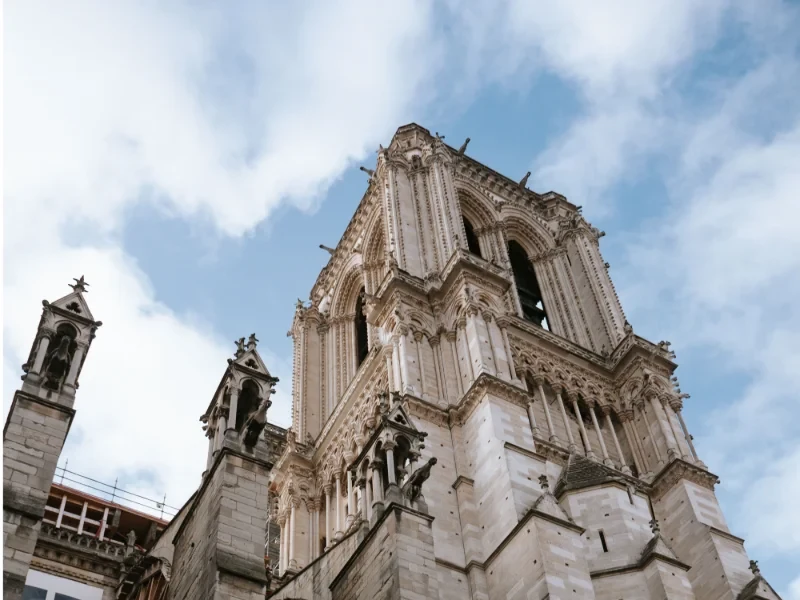
Some works deserve to be circled, observed from multiple angles, at different times. Notre-Dame's spire is one of them. This is precisely what Notre-Dame de Paris : les mystères de sa reconstruction offers: a 1.5-hour guided tour around the cathedral, led by an official lecturer who decodes every architectural detail for you. From the Pont au Double, you embrace the complete silhouette of the restored apse and spire. From the René Viviani square, you discover a unique plunging angle on the transept crossing. From the forecourt, you measure the monument's vertical power.
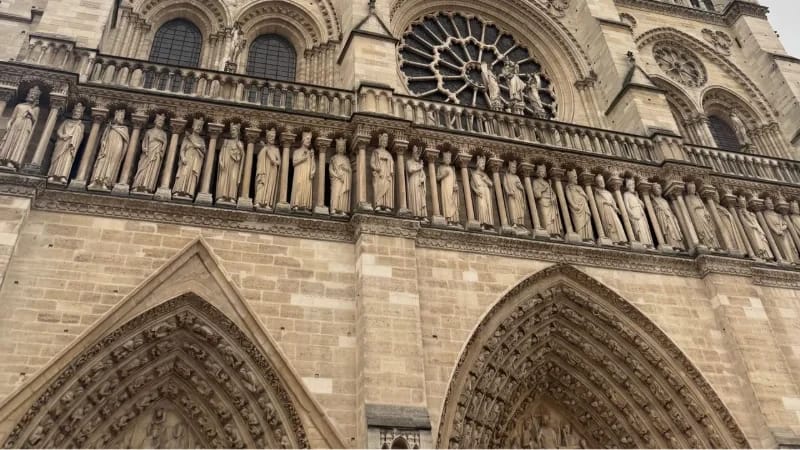
The guide points out the sixteen patinated copper statues replaced around the base of the spire - statues that, ironically, were taken down four days before the fire for restoration, which saved them from the flames. A miracle unnoticed by the general public. He also shows you the new shiny slate tiles on the roof, the sculpted hooks, the finesse of the Gothic ornaments restored identically. Every detail becomes a revelation. To experience this architectural immersion and leave with a fresh perspective on this iconic monument, count 14,50 € - a fair price for the richness of content you won't find in any paper guide.
Booking Your Slot to Observe the Architectural Details
Online booking is immediate, e-ticket in your mailbox right after payment. Meet at the Pont au Double, comfortable shoes, and eyes wide open. The new Notre-Dame spire awaits you to reveal its secrets to those who know how to listen.