The Challenge of Night Photography in Paris: Understanding the Obstacles
Photographing Paris at night is simultaneously one of the most rewarding and frustrating experiences for a photographer. Rewarding, because the City of Light offers one of the richest and most iconic nightscapes in the world. Frustrating, because three major obstacles stand in the way of those who wish to capture this magic.
The first obstacle is very low light. Despite the abundance of urban lighting, the overall scene remains much darker than a daytime shot. This requires working with long exposure times, high ISO settings, or wide apertures. Each of these solutions brings its own set of challenges: motion blur, digital noise, or shallow depth of field.
The second obstacle is extreme contrast. An illuminated monument like the Eiffel Tower or the Opéra Garnier features extremely bright areas (spotlights, garlands) and areas plunged into total darkness (the sky, unlit facades). The camera struggles to handle this dynamic, often leading to overexposed monuments that burn out details, or completely blocked shadows.
The third obstacle, specific to photography from a vehicle, is combined movement. Not only are you moving, but your subject remains fixed while it zooms past you. This makes traditional long exposures used to capture night monuments impossible. Added to this is the classic problem of windows: parasitic reflections, dirt, optical distortions.
From a classic tour bus, these three obstacles make night photography almost impossible for the amateur. Traditional windows reflect so much that you see more of the vehicle's interior than the exterior monument. The optical quality of the window distorts straight lines. And the vehicle's movement, without proper stabilization, guarantees blur. This is where the Bus Toqué® comes in with a remarkable technical solution.
Why the Bus Toqué® is an Ally for Your Night Photos
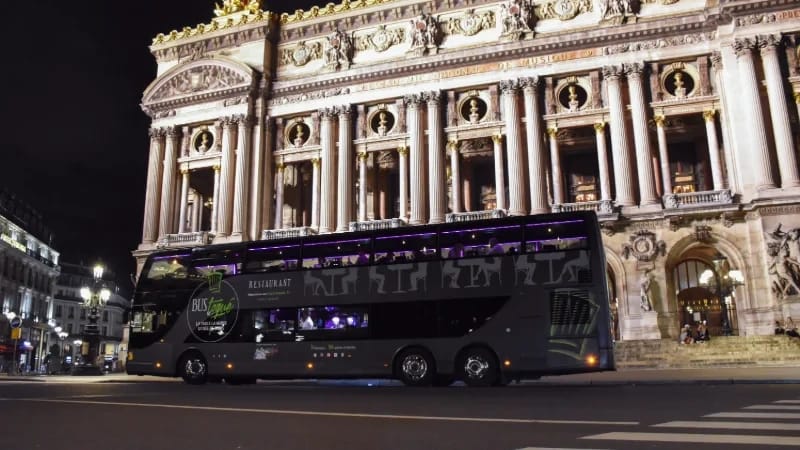
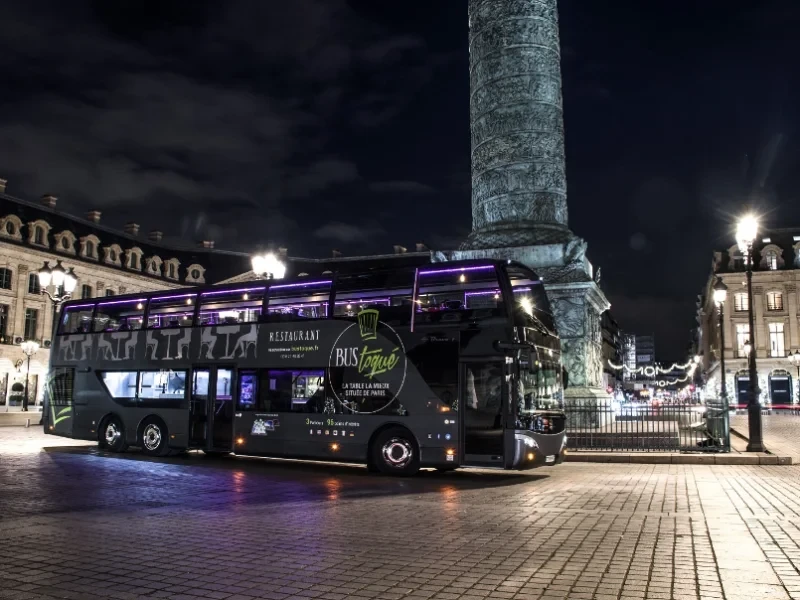
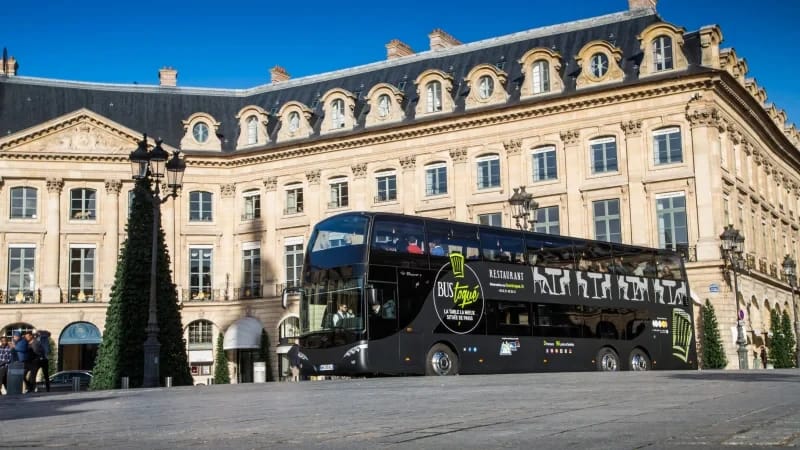
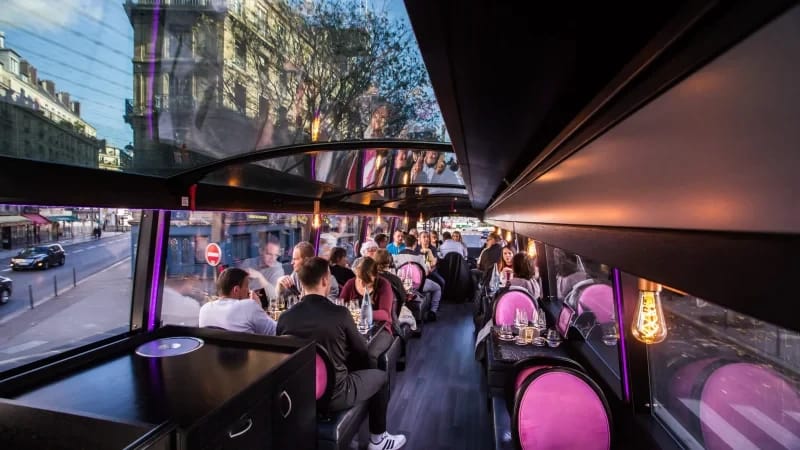
The Bus Toqué® is not an ordinary tour bus, and this is particularly evident for night photography. The vehicle has been specially designed with a high-quality optical panoramic glass roof, treated to minimize reflections and offer maximum transparency. It's not just simple glazing: it's a device designed not to pollute your visual experience.
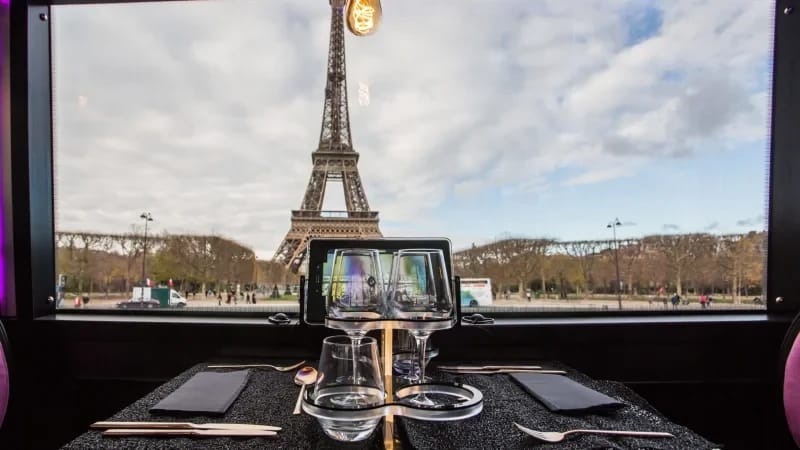
In practice, this anti-reflective treatment allows your camera (or smartphone) to capture the exterior monuments directly without fighting against the bus's interior lights. You thus get surprisingly sharp shots, with a rendering close to what you would have when photographing with the naked eye, in open air. It's a huge advantage over any other Parisian panoramic bus.
Another advantage is the privileged height of the upper deck. You are about 3 meters above the ground, placing you above most obstructive elements: streetlights, street furniture, traffic lights, other vehicles. Your shots benefit from a clear perspective, without a cluttered foreground. The monuments appear in all their majesty, without unnecessary visual distractions.
The relative stability of the bus also works in your favor. Unlike a river cruise where pitching can complicate long exposures, a double-decker bus moves more predictably on asphalt. You can anticipate movements, turns, stops at lights, and trigger your photos at the right moment. Some photographers even take advantage of red light stops to attempt slightly longer exposures, sometimes with splendid results.
Finally, there's the question of interior ambiance. On board the Bus Toqué®, the lighting is deliberately dimmed, both to create an intimate atmosphere and to avoid disturbing the outside view. This low interior light further reduces reflections on the glass roof and allows you to maintain your visual balance between the panoramic view and your plate.
Must-See Spots on the Bus Toqué® Night Route
To capture Paris at night in its most beautiful light, our Dîner Paris By Night is THE reference. Its departure at 8:30 PM for 110 € places you at the heart of the magic hour when all the lights are on, and the Parisian sky still holds those bluish hues perfect for the most spectacular photos. Here are the highlight moments of the route not to be missed.
First major spot: the Arc de Triomphe. Starting from the Champs-Élysées, the bus quickly engages in this historic axis, offering sweeping views of the illuminated monument. Be ready from the start: the first few minutes are particularly photogenic, with the avenue's perspective seemingly stretching infinitely.
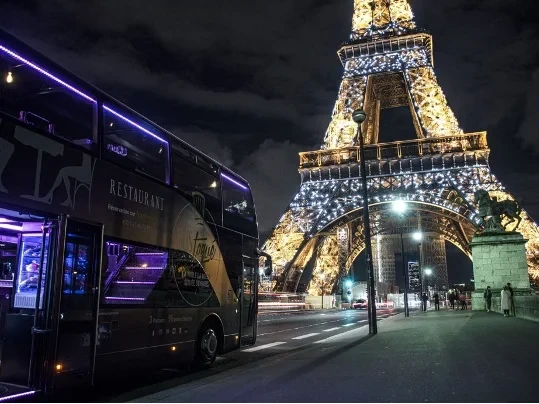
Second highlight: the Trocadéro and the Eiffel Tower. As the bus approaches the Trocadéro and then descends towards the Pont d'Iéna, you get one of the most iconic angles on the illuminated Eiffel Tower. If your passage coincides with the 5 minutes of golden sparkling (every hour on the hour at night), you experience an absolutely magical moment to capture without hesitation.
Third spot: the Pont Alexandre III and Les Invalides. This bridge, reputed as one of the most beautiful in the world, offers an exceptional view in line with the golden Invalides on one side, and the illuminated Grand Palais on the other. The ornate lampposts of the bridge add a unique depth of field. An absolutely iconic shot of Paris.
Fourth highlight: the Louvre and the illuminated pyramid. The route skirts the Cour Napoléon or the Quai du Louvre depending on the configuration, allowing you to capture the famous glass pyramid that seems to float in the darkness, magnified by its interior night lighting.
Fifth moment: the Concorde and its obelisk. The vast square crossed by the bus offers 360-degree views of the illuminated fountains, the golden obelisk, and the perspectives towards the Madeleine and the National Assembly. A night scene of perfect geometry.
Finally, don't overlook the Seine crossings, which offer sublime reflections of the monuments in the river's water. It's particularly spectacular from the Pont Alexandre III, Pont de la Concorde, or Pont d'Iéna.
Technical Tips for Bringing Back the Best Possible Photos
Now let's move on to the concrete technical tips that will make the difference between "okay" photos and truly memorable ones. These tips apply equally to smartphones and dedicated cameras.
First tip: always turn off the flash. The built-in flash will never reach far enough to illuminate an exterior monument, but it will perfectly light up the window, creating a harsh reflection that will ruin your photo. This rule is absolutely non-negotiable for night photography.
Second tip: press your lens against the window. By gently pressing the camera against the glass roof, you eliminate almost all remaining interior reflections. Ideally, use a small rubber lens hood, or even your hand as a visor around the lens. This is a formidable technique, systematically used by professional photographers.
Third tip: don't be afraid to increase your ISO. Modern sensors handle high ISO settings (up to 3200 or even 6400) perfectly well with quite acceptable quality. Better a bit of digital noise than a blurry photo due to too long an exposure time.
Fourth tip: use burst mode. On a moving vehicle, capturing the exact right moment with a single shot is almost impossible. Take three to five successive photos of each scene, and you can select the best shot later.
Fifth tip: anticipate red lights and stops. These moments of total stability are precious for attempting more composed framing, with slightly longer exposures revealing more details.
Last tip: don't forget to live in the moment. The best photo is the one you take, but the best evening is the one you fully experience. Wisely alternate between capturing and enjoying, without being glued to your screen. Paris deserves all your senses.